
Modular Hotel Construction: When It Pencils, and When It Does Not
Most of what is written about modular hotel construction is written by people selling it. This page is written by a factory that will tell you when your project is not a fit. Below is what modular does to a hotel schedule, what it did on two real projects, and the specific conditions under which it is the wrong choice.
Modular hotel construction builds guest room modules in a factory while site work happens at the same time, then sets the finished modules with a crane. For hotels, the advantage is schedule: rooms are being built during the months a site-built project would still be pouring foundations. It works best on 20 to 100 module projects with repeating room layouts, in markets where labor, weather, or a seasonal opening date is the real constraint. It works poorly where every room is different, where entitlements are unresolved, or where the site cannot take a crane.
What modular actually changes about a hotel schedule
site work and factory production run at the same time
- Site work
- Factory, set and finish
Modular breaks the sequence. While the site is being excavated and the foundations poured, the guest rooms are being built indoors, on a line, with the finishes already going in. The two tracks run at once and meet at the set. That is the whole idea, and it is why the schedule advantage on a hotel is usually larger than the cost advantage.
In a resort market the effect compounds, because the build window is short. A month lost in October can cost five months, since the site shuts down for winter and reopens in spring.
What it looked like on a real project
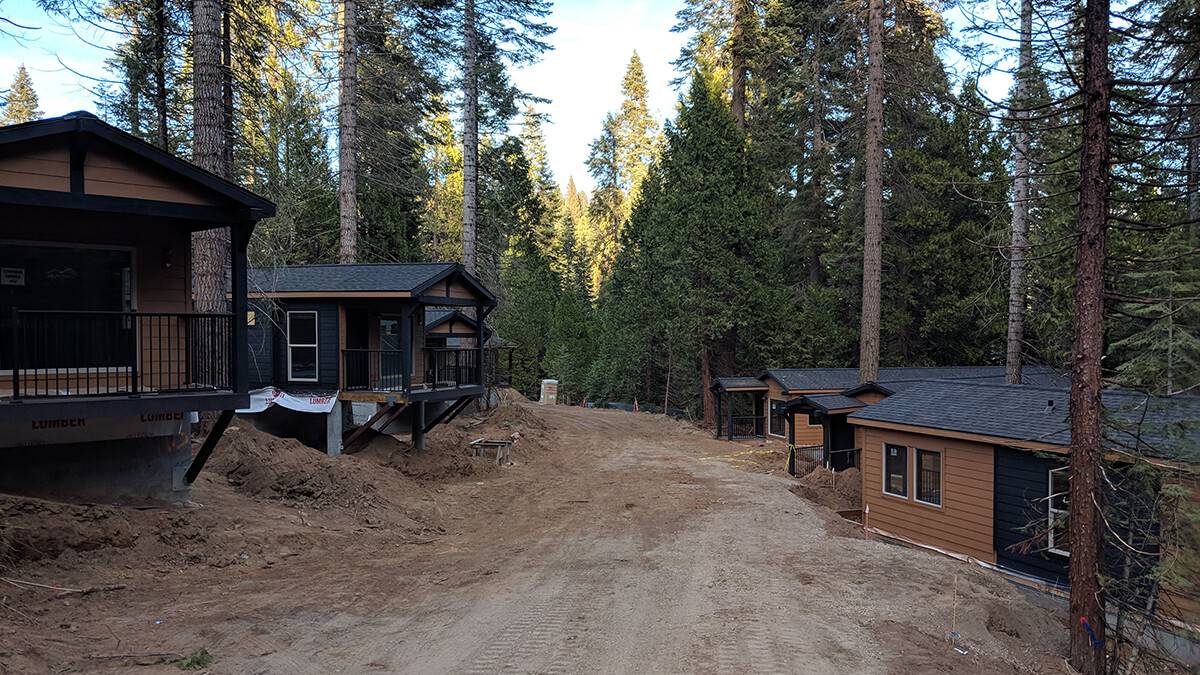
Explorer Cabins at Tenaya Lodge, Fish Camp, California
Tenaya Lodge needed more keys at the south gate of Yosemite and faced a choice: a steel and concrete hotel wing meaning two to three years of construction in a remote mountain market, or a standalone cabin product built in a factory. The site sits at elevation with a five-month winter shutdown, scarce local labor, and a hard June opening date carrying a $1M penalty.
They went modular. 27 cabins were set in October. 23 more were set in March, straight off the winter shutdown. Total set time for all 50 cabins was two weeks. Paving and landscaping finished around occupied buildings and the resort opened in May, ahead of the penalty date.
The Irontown post-completion review put the total impact at $6.8M: the $1M penalty avoided, direct cost savings of about 30 percent under the site-built budget, and three to four months of room revenue brought forward.
Fit criteria for hotel projects
We say no
Works when the units repeat closely
The sweet spot
You want a bigger factory than ours
We have built at 12, 15 and 16 modules when the site or the season made it worth it.
Modular hotel construction fits when:
- The project is 20 to 100 modules. That is where the economics are strongest. Between about 10 and 20 it still works when the units repeat closely, or when the site is remote or constrained enough that conventional building is slow and expensive. We have built at 12, 15 and 16 modules. Above 100, you want a larger factory than ours.
- Room layouts repeat. Guest rooms are the single best use case in all of modular construction, because a hotel is a building made of the same room over and over.
- The opening date has money attached to it, whether that is a season, a franchise agreement, or a penalty clause.
- The site is remote, labor-constrained, weather-constrained, or all three. Resort markets usually are.
- The owner can commit to design early. Modular front-loads decisions, which is a real cost and worth naming.
- The project sits in the Western US: Arizona, California, Colorado, Idaho, Montana, Nevada, Oregon, Utah, Wyoming.
When modular is the wrong call for a hotel
We turn down hotel projects. Here is when:
- Every room is different. Custom geometry erases the factory advantage, and you will pay for the line without benefiting from it.
- The project is under about 10 modules. Mobilization, transport and crane costs do not spread across enough units.
- Entitlements are unresolved or approvals are fragmented across agencies. The factory needs a committed design and an approval process that moves.
- The design team needs to keep making changes past the point where production would have started. Modular trades late flexibility for early speed. If you need the flexibility, take it.
- The site cannot physically take a crane and a truck. This is usually a remote-site problem rather than an urban one. Narrow canyon roads, switchbacks, low clearances and bridge weight limits stop modules more often than a tight city lot does, and urban infill is typically easier to stage a crane and trucks into than a resort site an hour up a mountain.
- If your project is on this list, a feasibility review will tell you so in the first conversation rather than the fifth.
The timeline, concretely
- What runs in parallel
- Feasibility and design commitment happen first, and take longer than most owners expect. This is where modular projects are won or lost.
- Once production starts, the factory build for a hotel of this size runs roughly 4 to 9 months depending on module count and phasing. The Huff House expansion in Jackson was 16 modules in 4 months. Tenaya was 50 cabins in 9 months across two phases.
- Site work, foundations, and utilities run during those same months rather than after them.
- The set is measured in days or weeks, not months. Two weeks for 50 cabins at Tenaya.
- Stitch, finish, and inspection follow the set, then occupancy.
Common questions
How much faster is modular hotel construction?
It depends on the market more than the building. On the Huff House Inn expansion in Jackson, Wyoming, the overall time saved was about 12 months, driven by resort-town seasonality. In markets with a normal build season the advantage is smaller. The gain comes from running factory and site work at the same time, so the more your site is constrained by weather, labor, or access, the more you save.
Is modular cheaper than site-built for a hotel?
Sometimes, and it is the wrong first question. On the Tenaya project the direct cost came in about 30 percent under the site-built budget, but that was a remote site with very high local labor costs. In an easy market with cheap labor the direct costs can be close to even. The reliable advantage is schedule and cost certainty, not a lower sticker price.
What size hotel project makes sense for modular?
For our factory, 20 to 100 modules is the sweet spot. We build smaller, down to about 10 modules, when the rooms repeat closely and the market is hard to build in. Under about 10, the fixed costs of mobilization and transport do not spread across enough units. Above 100, you are better served by a larger factory.
Do modular hotels meet the same building codes?
Yes. Modular buildings are built to the same IBC and IRC codes as site-built, and are inspected during construction in the factory. Regulation happens at the state level rather than the local level. The building that arrives is a code-compliant permanent structure.
What happens if the design changes after production starts?
It costs you. This is the real tradeoff of modular and the reason we push so hard on early design commitment. If your project needs to keep changing through construction, modular is probably the wrong delivery method and we will say so.
How are the modules delivered and set?
By truck, then crane. Site access is a genuine constraint and one of the first things a feasibility review checks. Some sites cannot take the equipment, and that is a hard no rather than a problem to solve.
Where does Irontown build hotel projects?
The factory is in Spanish Fork, Utah, and we serve the Western US: Arizona, California, Colorado, Idaho, Montana, Nevada, Oregon, Utah, and Wyoming.
How early should we talk to a factory?
Earlier than most owners do. Modular decisions are cheapest at the feasibility stage and most expensive after design is complete. If you are weighing modular against site-built, that is the right moment, not after the drawings are done.
Still early? Take the project sheets.
One page each on Tenaya, TOSA, and Big Sur: what the developer was facing, what modular did, and the numbers as they landed.
Have a hotel project with a site and an opening date?
A feasibility review looks at economics, schedule, logistics and your goals, and tells you if it does not pencil. Consultative, not a sales process.
Request a feasibility reviewor call 1-877-849-1215