
Modular Resort Cabins: The Expansion Math
A resort that needs more keys has two real options, and they are not close to equivalent. This page walks the decision a resort near Yosemite actually made, what it produced, and the conditions under which cabins are the wrong answer.
Modular resort cabins are standalone guest cabins built as finished modules in a factory and set on prepared foundations at a resort property. Irontown Modular builds resort cabins at its factory in Spanish Fork, Utah, for resort and hospitality clients across the Western US. Compared with a conventional hotel expansion, cabins typically carry a higher nightly rate, a shorter construction schedule and less disruption to an operating property. Irontown set 50 cabins at Tenaya Lodge near Yosemite in two weeks of total set time.
The decision: cabins or a hotel wing
- Modular resort cabin
- Conventional hotel room
A steel and concrete multi-story hotel expansion means two to three years of construction on an operating property, a high cost per door in a remote market, and rooms that earn what your other rooms earn.
A standalone cabin product means about a year of construction, factory-built units, and a different guest experience that commands a different rate. At Tenaya, cabins were positioned at $700 to $800 per night against $200 to $300 for conventional rooms, and the expansion was projected to break even in five years or less.
That rate gap is the entire argument, and it is worth being precise about why it exists. A cabin in the woods is not a hotel room with a different roof. It is a distinct product with its own guest, and it prices accordingly. If your property cannot support that positioning, the math changes and cabins may not be the right call.
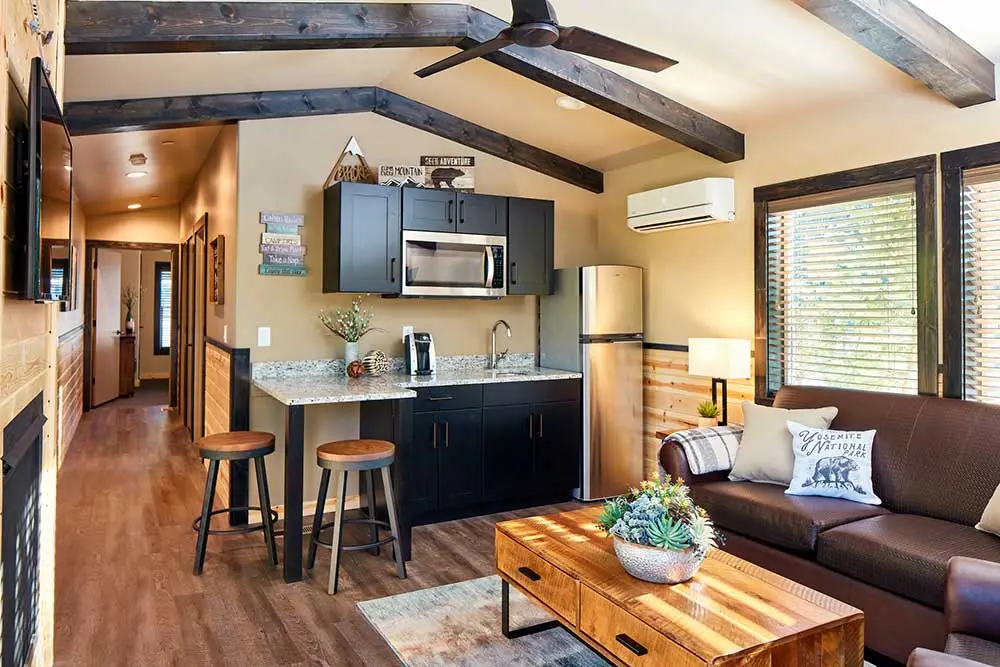
What it looked like on a real project
Explorer Cabins at Tenaya Lodge, Fish Camp, California
Tenaya sits at the south gate of Yosemite, at elevation, with a five-month winter shutdown, scarce local labor and a hard June opening date carrying a $1M penalty. Site-building 50 cabins would have run into the shutdown and completed in August at the earliest.
They went modular and phased it. 27 foundations were ready in October and 27 cabins were set in October. 23 more were set in March, straight off the winter shutdown. Total set time for all 50 cabins was two weeks. Paving, landscaping and site electrical finished around occupied buildings from the break of snow to the opening in May.
The Irontown post-completion review put the total impact at $6.8M: the $1M penalty avoided, direct cost savings of about 30 percent under the site-built budget, and three to four months of room revenue brought forward.
The part most cabin projects underestimate
Roads, utilities and grading are the larger half of a remote cabin project.
- Land and infrastructure $13.8M
- Cabins $6.0M
- Everything else $2.2M
At Tenaya, the cabin modules were $6M of a $22M total project. Land and infrastructure were $13.8M. Cabin sites and foundations were another $1M, and the clubhouse was $1.2M.
That proportion is typical and it is the single most useful thing to know before starting. Modular compresses the vertical construction, which on a spread-out cabin project is the smaller share of the budget. Roads, utilities, grading and drainage across a wooded site do not get faster because the buildings arrive finished.
The schedule advantage is still real and at Tenaya it was worth $6.8M. But a resort that budgets as though the cabins are the project will be wrong by a wide margin.
Phasing, which is where cabins have an edge
Cabins can be delivered in waves against foundations as they become ready, which is exactly what Tenaya did: 27 in October, 23 in March.
That matters for two reasons. It lets construction continue around a winter shutdown instead of stopping dead. And it lets a resort open revenue-generating units while later phases are still being set, which a single large hotel wing cannot do.
If your site develops in sections or your financing releases in tranches, phasing is a structural advantage worth designing around from the start.
Fit criteria
We say no
Works when the units repeat closely
The sweet spot
You want a bigger factory than ours
We have built at 12, 15 and 16 modules when the site or the season made it worth it.
Modular resort cabins fit when:
- The property can support a rate premium for a distinct cabin product. This is the assumption the whole model rests on.
- The project is 20 to 100 cabins. That is where the economics are strongest, and Tenaya was 50. Smaller counts can work down to about 10 when the cabin repeats and the site is remote.
- The cabin design repeats, with variation in siting and orientation rather than in the building itself.
- The site is remote, seasonal, or has a short building window. That is where the schedule advantage compounds.
- There is an opening date with money attached, whether a season, a booking window or a penalty clause.
- The project sits in the Western US: Arizona, California, Colorado, Idaho, Montana, Nevada, Oregon, Utah, Wyoming.
When this is the wrong call
We turn down resort cabin projects. Here is when:
- Every cabin is architecturally different. Custom geometry erases the factory advantage and you pay for the line without using it.
- The site infrastructure is undefined. If roads, utilities and grading are unresolved, the cabins are the least of the schedule risk and the budget is not yet real.
- The count is under about 10. Mobilization and crane costs do not spread.
- The property cannot support the rate positioning the model depends on. In that case a conventional room addition may genuinely be the better investment.
- Terrain or access prevents crane and truck delivery to the cabin pads. On wooded and sloped sites this is checked first and it is sometimes a hard no.
Common questions
Are cabins better than a hotel wing for adding keys?
Often, but it depends on rate. At Tenaya the cabins were positioned at $700 to $800 per night against $200 to $300 for conventional rooms, with a projected break-even under five years. That premium is what makes the model work. If your property cannot command it, a conventional addition may be the better call.
How many cabins can you set at once?
At Tenaya, 50 cabins were set in two weeks of total set time, across two phases. Rate of set depends on crane access, pad readiness and site circulation more than on factory output.
Can the project be phased?
Yes, and it is one of the real advantages. Tenaya set 27 in October and 23 the following March, which let work continue around a five-month winter shutdown and let earlier units come online first.
Do modular cabins hold up to snow and four-season use?
Yes. They are built to the same IBC and IRC codes as site-built and engineered for the snow and wind loads of the location. Tenaya operates as a four-season property.
What share of the budget is the cabins?
Smaller than owners expect. At Tenaya, cabin modules were $6M of a $22M total project, with $13.8M in land and infrastructure. Budget the civil work as the main event.
Is this the same as a park model or glamping unit?
No, and the difference is legal rather than cosmetic. Resort cabins here are permanent buildings on permanent foundations built to IBC or IRC. Park models are built to ANSI 119.5 and are classified as recreational vehicles. Different code, different siting rules, different financing. See our glamping page if that is closer to what you need.
How long does a resort cabin project take?
Tenaya was a 9 month modular build across two phases inside a 4 year total project, of which two years were feasibility, acquisition and entitlement. The buildings are rarely the long pole.
Where does Irontown build resort cabins?
The factory is in Spanish Fork, Utah, and we serve the Western US: Arizona, California, Colorado, Idaho, Montana, Nevada, Oregon, Utah and Wyoming, including national park gateway and mountain resort markets.
"There's more to the bottom line than just the hard cost."Kam Valgardson, President, Irontown Modular
Still early? Take the project sheets.
One page each on Tenaya, TOSA, and Big Sur: what the developer was facing, what modular did, and the numbers as they landed.
Weighing cabins against a hotel wing?
A feasibility review looks at economics, schedule, logistics and your goals, and tells you if it does not pencil. Consultative, not a sales process.
Request a feasibility reviewor call 1-877-849-1215