
Modular Multifamily Construction: When It Pencils, and When It Does Not
Apartment buildings are the second best use case in modular construction, after hotels, for the same reason: they are buildings made of the same unit repeated. This page covers what modular does to a multifamily schedule, what it did on a 4-story building in a historic Salt Lake City district, and the conditions under which we would tell you to build it conventionally.
Modular multifamily construction builds apartment units as finished modules in a factory while site work and foundations happen at the same time, then stacks them with a crane. On a 4-story, 32-unit building in Salt Lake City, Irontown Modular set the structure in 4 days and the building reached occupancy 12 months after factory production began, at a total cost on par with site-built in the same historic neighborhood. It fits projects of 20 to 100 modules with repeating unit layouts.
What modular changes about a multifamily schedule
site work and factory production run at the same time
- Site work, set and finish
- Factory production
On an infill site, that is worth more than it sounds. The laydown area shrinks, the critical path shortens, and the months of scaffolding, deliveries, noise and closed sidewalks that make neighbors and city councils hostile mostly do not happen. For a developer working in a historic district or a neighborhood with an active planning board, the disruption avoided is not a soft benefit. It is often what makes the project approvable.
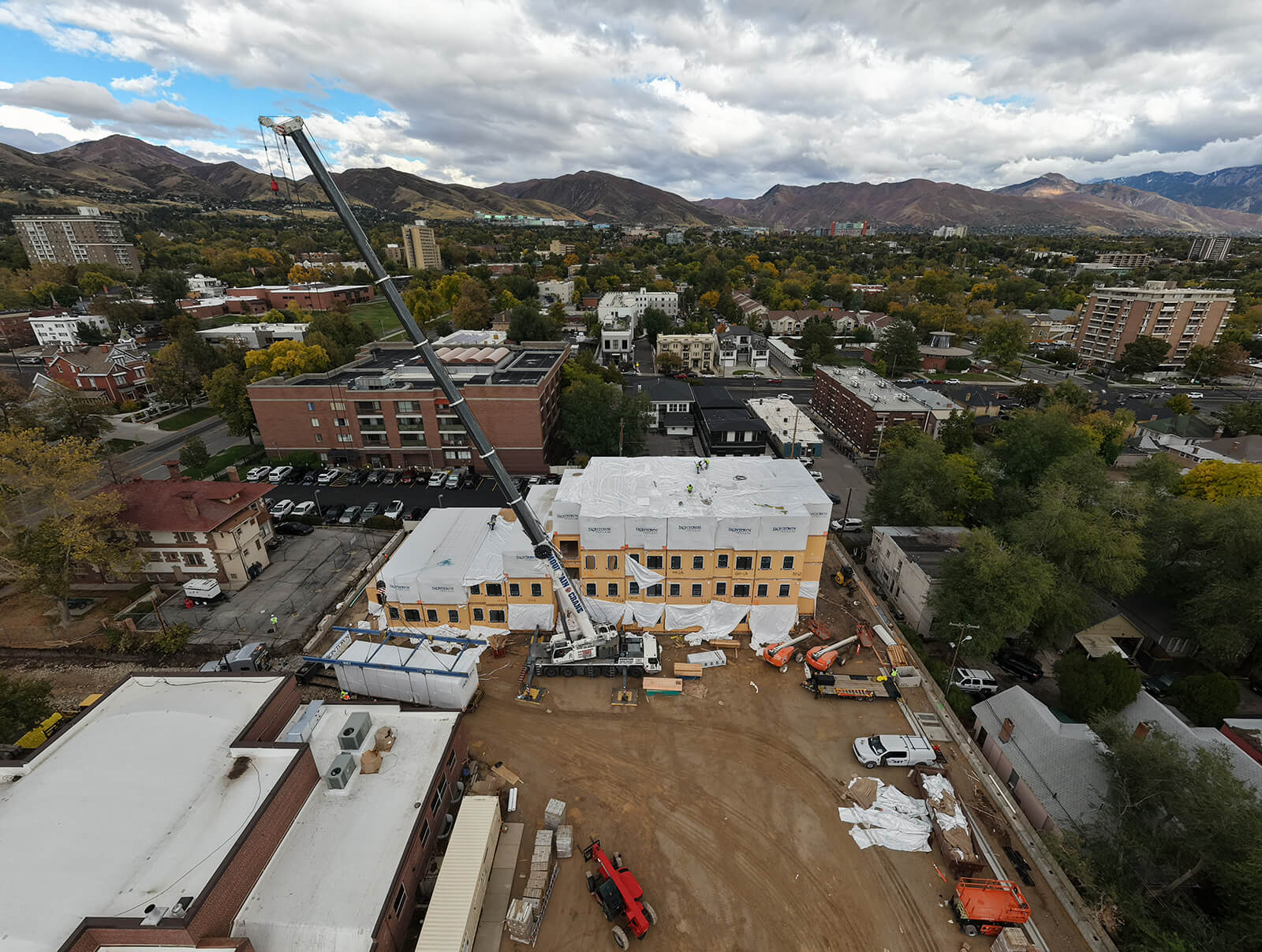
What it looked like on a real project
$312,500 per unit as delivered, on par with site-built in the same historic area.
- Modules, built in the factory $6.0M
- Site, foundation and cladding $2.0M
- Delivery, set and finish $1.7M
The Other Side Prep School, Salt Lake City, Utah
A nonprofit developer needed a 4-story, 32-unit supportive housing building in a historic Salt Lake City district, on a lot parceled from the back yard of a historic home, and needed it open as fast as possible. Every month of construction was a month the mission waited.
Factory production started in January 2025 while approvals and site work continued. The permit issued in July 2025. The factory finished in September. The 48 modules were craned into place in 4 days in October 2025, then stitched, clad in brick, Hardie and stucco to satisfy historic approvals, and finished. Occupancy was January 2026.
Total delivered cost was $10M, roughly $312,500 per unit as built, which the team assessed as comparable to site-built construction in the same historic area. That equivalence is the point. The developer paid site-built money and still had doors open 12 months after production started, on a 7 month on-site window with a 4 day set. The return was not a cheaper building. It was a faster one at the same price.
Where else this has worked
Ida Street Townhomes, San Rafael, California. 15 modules, 8,200 square feet of infill townhomes on a constrained urban lot, with roughly 6 months saved against a site-built schedule.
Yellowtail Townhomes, Big Sky, Montana. 31,500 square feet of golf course townhomes built in two phases, with roughly 18 months saved, almost entirely because a Montana mountain site has a short building season and a factory does not.
The pattern across all three: the tighter the site or the shorter the season, the larger the modular advantage.
The timeline, concretely
- Design and commitment come first and take longer than most developers expect. TOSA started plans in mid 2023. This is where modular projects are won or lost.
- Factory production runs in parallel with approvals and site work. TOSA started production in January 2025, before the building permit issued in July.
- Factory completion, then transport and set. Four days for 48 modules at TOSA.
- Stitch, cladding, inspection, then occupancy. Three months at TOSA, October set to January occupancy.
Fit criteria
We say no
Works when the units repeat closely
The sweet spot
You want a bigger factory than ours
We have built at 12, 15 and 16 modules when the site or the season made it worth it.
Modular multifamily fits when:
- The project is 20 to 100 modules. That is where the economics are strongest. Between about 10 and 20 it still works when the units repeat closely, or when the site is remote or constrained enough that conventional building is slow and expensive. We have built at 12, 15 and 16 modules. Above 100, you want a larger factory than ours.
- Unit layouts repeat. A building of identical two-bedroom apartments is close to the ideal modular project.
- The site is tight, urban, in a historic district, or in a market with a short building season.
- You are up to about 4 stories over a crawl space or podium. TOSA is 4 stories with an elevator and two stairwells, built and occupied.
- The owner can commit to design early, because production has to start before you would normally be done deciding.
- The project sits in the Western US: Arizona, California, Colorado, Idaho, Montana, Nevada, Oregon, Utah, Wyoming.
When this is the wrong call
We turn down multifamily projects. Here is when:
- The unit mix is highly varied and every floor plan is different. Repetition is the entire economic engine.
- The project is under about 10 modules. Transport, crane and mobilization do not spread across enough units.
- The design has already advanced down a site-built path. Once the drawings are developed without modular in mind, the project is a square peg. We cannot force it into a modular method, and the honest options are to redesign for modular or to build it on site.
- The site cannot take a crane and truck access. This is usually a remote-site problem rather than an urban one. Narrow canyon roads, switchbacks, low clearances and bridge weight limits stop modules more often than a tight city lot does, and urban infill is typically easier to stage a crane and trucks into.
- The pro forma depends on modular being dramatically cheaper. Modular is only dramatically less expensive when the site build is dramatically expensive and modular solves the biggest and baddest problems on that site. Otherwise savings are typically moderate or close to even. The schedule is where the money is.
Common questions
How long does a modular apartment building take?
TOSA went from factory production start to occupancy in 12 months, including a permit that issued halfway through. The on-site window was 7 months and the set itself was 4 days. Your timeline depends most on how quickly design gets committed, which is the part owners consistently underestimate.
Is modular multifamily cheaper than site-built?
Not reliably, and anyone promising that is selling. TOSA came in at roughly $312,500 per unit as built, which was comparable to site-built in the same historic area. The advantage is schedule and cost certainty. In markets with expensive or scarce labor, or short building seasons, direct costs can also come in lower, but that is a market condition rather than a property of the method.
How many stories can you build modular?
We have built and occupied 4 stories with an elevator and two stairwells. Taller is possible in modular generally, but it moves you toward factories set up for high-rise work.
Does modular work in a historic district?
Yes. TOSA sits in a historic district in Salt Lake City and met historic approvals with brick, Hardie and stucco cladding plus storefront glazing. The cladding goes on after the set, so the exterior can be whatever the design review requires.
Will the building look modular?
No. Modular is a method, not a type. TOSA reads as a conventional 4-story brick apartment building because that is what it is. The only difference is where the units were assembled.
Does this work for affordable or supportive housing?
Yes, and it is a strong fit. TOSA is permanent supportive housing funded through nonprofit, state, church and private sources. Funded projects usually have a window, and modular is a way to open inside it.
What about appraisal and financing?
A modular building is a permanent, code-compliant structure on a permanent foundation and appraises as real property, the same as site-built. It is inspected during construction in the factory and again on site.
How early should we involve a factory?
At feasibility, before design is complete. Modular decisions are cheapest early and most expensive after the drawings are done. If you are weighing modular against conventional construction, that is the moment to call, not after.
“Modular is a building method, not a building type. It is still a permanent, high quality result. We just got there using an advanced method.”Kam Valgardson, President, Irontown Modular
Still early? Take the project sheets.
One page each on Tenaya, TOSA, and Big Sur: what the developer was facing, what modular did, and the numbers as they landed.
Have a multifamily project with a site and a timeline?
A feasibility review looks at economics, schedule, logistics and your goals, and tells you if it does not pencil. Consultative, not a sales process.
Request a feasibility reviewor call 1-877-849-1215